Outdoor HVAC noise: two fans and operating time
Two equal outdoor fans can have the same total period-average contribution as one fan running continuously when each runs for half the period. This worked example separates propagation, energy addition and operating time using explicit synthetic inputs.
Start a free calculationTwo fans and one receiver
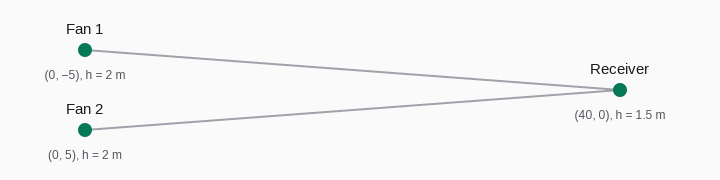
Fan 1 is at (0, −5), fan 2 at (0, 5), both 2.0 m above flat ground. The receiver is at (40, 0), height 1.5 m. Each direct path is about 40.3144 m. Both fans have the same whole-source sound power spectrum: 90, 94, 96, 93, 89, 85, 80, 72 dB at 63, 125, 250, 500, 1000, 2000, 4000 and 8000 Hz. These are invented values, not a fan catalogue entry.
Each fan runs for 8 hours in the default 16-hour day period of a browser project without an assessment framework. G = 0, temperature 15 °C and relative humidity 70% are the current browser defaults. There are no screens, buildings or reflections. The result uses favourable propagation conditions, method cnossos-eu:2021, core 0.1.0.
Separate the operating-time correction from the sum
For favourable propagation conditions, the draft engine gives 51.34396581 dBA for each half-period contribution and 54.35426576 dBA for their energy sum. A half-period correction is 10 log10(8/16) = −3.0103 dB; adding two equal independent contributions adds 3.0103 dB. The two changes cancel in this particular symmetric example.
The period-average energy is the same whether the half-period fan operations overlap or alternate, provided each fan has the stated sound power and total operating duration. The instantaneous combined level and maximum level can differ; this example calculates neither a maximum event level nor a tonal penalty.
| Quantity at the receiver | Level, dBA |
|---|---|
| Fan 1 alone, continuous for 16 h | 54.35 |
| Fan 1, 8 h in 16 h | 51.34 |
| Fan 2, 8 h in 16 h | 51.34 |
| Both fans, each 8 h in 16 h | 54.35 |
| Both fans, each continuous for 16 h | 57.36 |
Set up a useful HVAC comparison
- Record which sound path the manufacturer data describes: casing breakout, intake or discharge. Keep its operating point with the spectrum.
- Model each physical emitter once. Use actual height, location and directivity where the method supports them; these synthetic sources are omnidirectional.
- Use the default 16-hour day without an assessment framework and enter 480 operating minutes for each fan. Do not apply a second duration correction to an already period-averaged source input. The download is reference data for core reproduction, not a browser import file.
- To compare a relocated plant or screen, keep the source spectra and receiver positions consistent. Inspect each contribution as well as the total.
What this example does not establish
This is an outdoor point-source propagation example. It does not size a duct silencer, predict indoor room noise, identify a local assessment limit or establish regulatory compliance. Finite source dimensions, reflections, background sound and tonal characteristics can matter on a real site.
The software method remains a draft without independent validation. Read the verification page before interpreting the numbers as an engineering prediction.
Early preview. Screening-level estimates do not replace an assessment by a qualified specialist. The calculation is free and you can start without an account.